From the Renaissance to Contemporary Art: Florence's Living Artistic Spirit
A city that changed the course of art history continues, even today, to seek new ways of interpreting the world.
A city that changed the course of art history continues, even today, to seek new ways of interpreting the world.
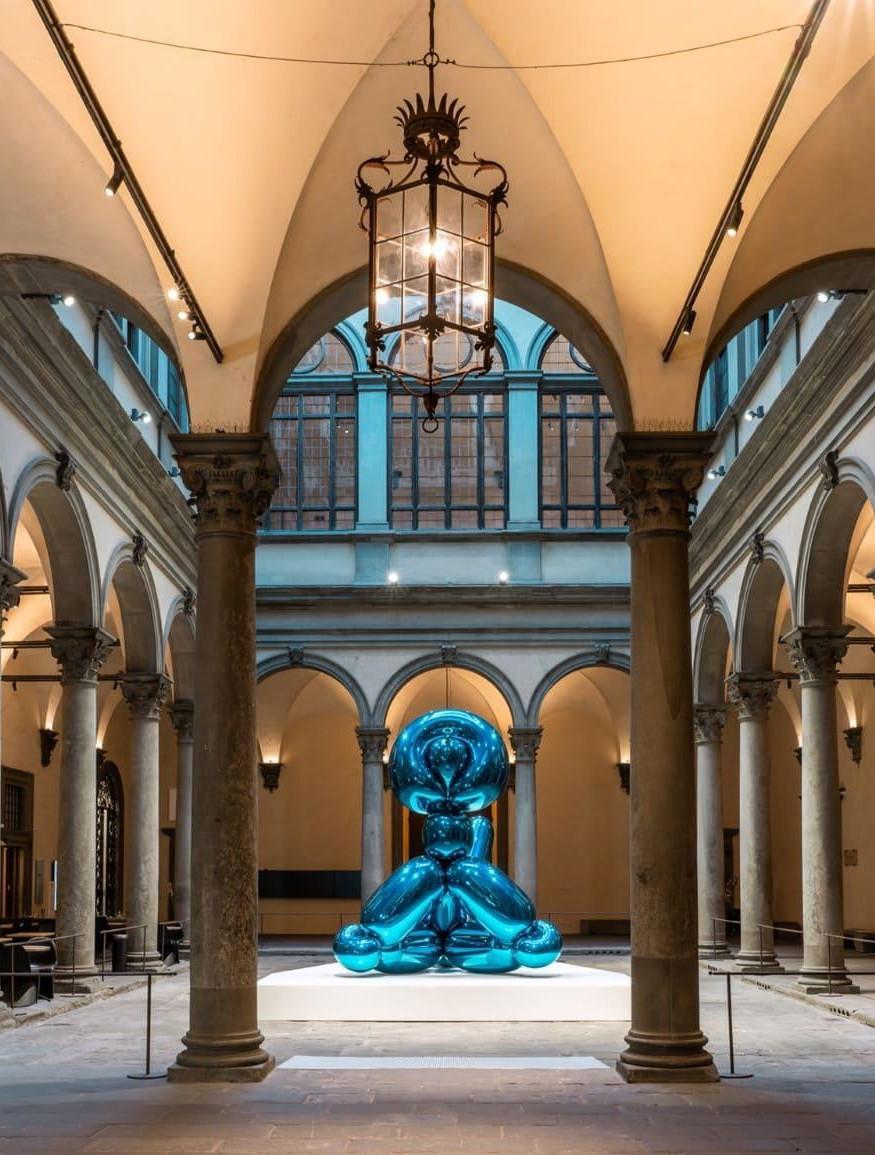
Florence is a city that seems naturally connected to the past. Its squares, palaces and churches preserve some of the most important masterpieces in Western art history. Yet beyond this familiar image lies another Florence, one that continues to question, experiment and embrace new forms of artistic expression.
From the Renaissance to contemporary art in Florence, the relationship between creativity and the city has never been interrupted. The ways of representing reality have changed, as have materials and perspectives, but art's ability to transform the way we see the world remains.
Discovering this continuity means exploring Florence not as a city frozen in time, but as a place where different eras continue to meet.
Today, we regard the Renaissance as an era to admire. For the artists who lived through it, however, it represented a period of radical transformation.
Brunelleschi revolutionised the understanding of architectural space. Donatello brought new expressive power to sculpture. Masaccio experimented with a pictorial language based on perspective and the representation of volume. Botticelli and Michelangelo helped redefine the relationship between beauty, the human figure and intellectual thought.
What we now call Renaissance art was, in its own time, a form of modernity.
Walking between the Duomo, Piazza della Signoria, the Uffizi and Florence's great basilicas means encountering a city that did not simply preserve culture, but constantly sought to reinvent it.
It is precisely this spirit that connects fifteenth-century Florence with its contemporary artistic identity.
In Piazza Santa Maria Novella, the Museo Novecento reveals a different chapter of Florence's artistic history.
Housed in the former Spedale di San Paolo, the museum is dedicated to twentieth- and twenty-first-century art. Its collections include significant works of twentieth-century Italian art, complemented by temporary exhibitions and contemporary projects.
Here, the artistic language changes. Forms break free from convention, representation becomes exploration, and a work of art no longer needs to reproduce reality. Instead, it may interpret, question or transform it.
Visiting the Museo Novecento after exploring the galleries of the Uffizi means experiencing two very different expressions of the same creative impulse: the desire to find new ways of expressing one's own time.
Just a short walk from the elegant streets of Florence's historic centre, Palazzo Strozzi offers one of the most compelling examples of the relationship between historic heritage and contemporary art.
A masterpiece of Renaissance architecture, the palazzo hosts an exhibition programme spanning different periods and artistic languages. Over the years, it has welcomed exhibitions dedicated to major figures in modern and contemporary art, including Ai Weiwei, Marina Abramović, Olafur Eliasson, Anish Kapoor and Mark Rothko.
Part of Palazzo Strozzi's fascination lies in this contrast: works created to question the present enter a space designed centuries earlier, establishing unexpected connections.
The Renaissance becomes more than a backdrop for contemporary art. It becomes part of the conversation.
To discover contemporary Florence, it is worth venturing beyond the city's best-known museums.
In the Santa Croce district, MAD – Murate Art District occupies part of a historic complex that has served as both a convent and a prison over the centuries, before being transformed into a cultural space open to the city.
Today, it is a centre dedicated to artistic research and production, hosting exhibitions, performances, talks, workshops and artist residencies.
Here, art is not simply something to observe once it has been completed. It is a process that takes shape, engages people and explores questions relating to society, memory and the present.
This is a less predictable side of Florence, where creativity continues to offer new ways of interpreting the world.
Florence's artistic life extends far beyond its major cultural institutions.
Alongside museums, art galleries in Florence, artists' studios and independent spaces help maintain the city's connection with emerging generations of artists.
Between the historic centre and the Oltrarno, the tradition of Florentine workshops meets contemporary practices spanning painting, photography, sculpture, installation art and design.
It is another form of continuity with the past. For centuries, Florence was a city of artisans, workshops and experimentation, where artistic knowledge was passed down through everyday practice.
Today, that dialogue continues through different techniques and materials, while preserving the importance of craftsmanship, creativity and individual exploration.
Discovering art in Florence across different periods does not necessarily require a tightly planned itinerary.
A day might begin among the Renaissance masterpieces of the Uffizi before continuing to Palazzo Strozzi, where temporary exhibitions offer constantly changing perspectives. From there, a short walk leads to Piazza Santa Maria Novella and the Museo Novecento.
Another day might be devoted to Santa Croce, its artistic heritage and the contemporary spaces of Le Murate.
The pleasure of this itinerary lies in the possibility of moving from one century to another simply by crossing a square or turning into a different street.
It is not about comparing eras to decide which produced the most important art. It is about understanding how each generation has searched for its own language to express the human experience.
In the heart of the historic centre, Palazzo Ruspoli offers a natural starting point for discovering this dimension of the city.
The Duomo, the Uffizi, Palazzo Strozzi and the Museo Novecento are all within walking distance, making it possible to shape days around art while enjoying the freedom to experience Florence at your own pace.
An exhibition in the morning, a walk among Renaissance architecture, a return to the tranquillity of your private residence and, later, another encounter with the city.
Living in a historic palazzo also means experiencing first-hand the continuity between past and present that makes Florence so distinctive.
Because art does not belong only to the places where it is exhibited. It also lives in the spaces we move through, the light we observe and the way we learn to see the world around us.
Be inspired by our curated recommendations and discover museums, exhibitions, galleries and remarkable places selected to help you experience Florence through art, from the Renaissance to its most contemporary expressions.