The Ospedale degli Innocenti: A New Idea of Architecture
The itinerary can begin in Piazza della Santissima Annunziata, in front of the portico of the Ospedale degli Innocenti.
Brunelleschi was commissioned to design the building in 1419, and its loggia represents one of the earliest major expressions of Renaissance architecture. Rounded arches, pietra serena columns, and white plaster create a space based on a repeating module, conveying an immediate sense of order and harmony.
Its modernity lies less in decoration than in the relationship between its individual elements. Looking at the portico reveals one of the fundamental principles of Brunelleschi's architecture: space can be measured, ordered, and made comprehensible through proportion.
It is one of the best places to begin reading the architectural language of Renaissance Florence.
San Lorenzo and the Geometry of Space
Continuing towards San Lorenzo, Brunelleschi's architectural language becomes even more apparent.
The fifteenth-century reconstruction of the basilica was designed by the architect under the patronage of the Medici family. Inside, the regular succession of columns, arches, and bays expresses the pursuit of balance and proportion that would become one of the defining characteristics of Renaissance architecture.
But it is in the Old Sacristy, where Brunelleschi worked between 1422 and 1428, that his vision is distilled into a more intimate space. Geometry, pietra serena, and pale surfaces create an interior in which every element seems to find its natural place.
Here, architecture does not simply ask to be observed. It invites you to experience space itself.
The Pazzi Chapel: When Harmony Becomes Silence
The itinerary continues within the complex of Santa Croce, where the Pazzi Chapel stands in the first cloister.
Considered one of Brunelleschi's most important creations, the chapel takes his pursuit of simplicity even further. White plaster contrasts with the grey of pietra serena, while geometry and proportion define the space with remarkable precision.
It is an architecture that seems to subtract rather than add. Decoration gives way to balance, while monumentality yields to a sense of measure.
Entering the Pazzi Chapel after passing through the lively surroundings of Santa Croce means encountering one of the most intimate expressions of the Florentine Renaissance.
Santo Spirito: Crossing the Arno to Rediscover Brunelleschi
To complete this journey, you need to cross the river.
In the Oltrarno district, the Basilica of Santo Spirito represents one of the most important examples of Brunelleschi's conception of space. Brunelleschi began developing the project as early as the 1420s; following his death in 1446, construction continued with some changes to his original vision.
The interior nevertheless retains the strength of his idea: a rhythmic succession of columns and chapels that makes the organisation of the space immediately clear.
Reaching Santo Spirito by walking through the historic centre and across the Arno adds another dimension to the experience. The monumental heart of Florence gradually gives way to a neighbourhood still deeply connected to the city's everyday life.
Another Way of Seeing Florence
Following Brunelleschi in Florence reveals that his legacy is not contained within a single monument.
From the Ospedale degli Innocenti to San Lorenzo, from the Pazzi Chapel to Santo Spirito, a language emerges based on proportion, geometry, light, and rhythm. It is a new way of conceiving architecture that would help define the very image of the Renaissance.
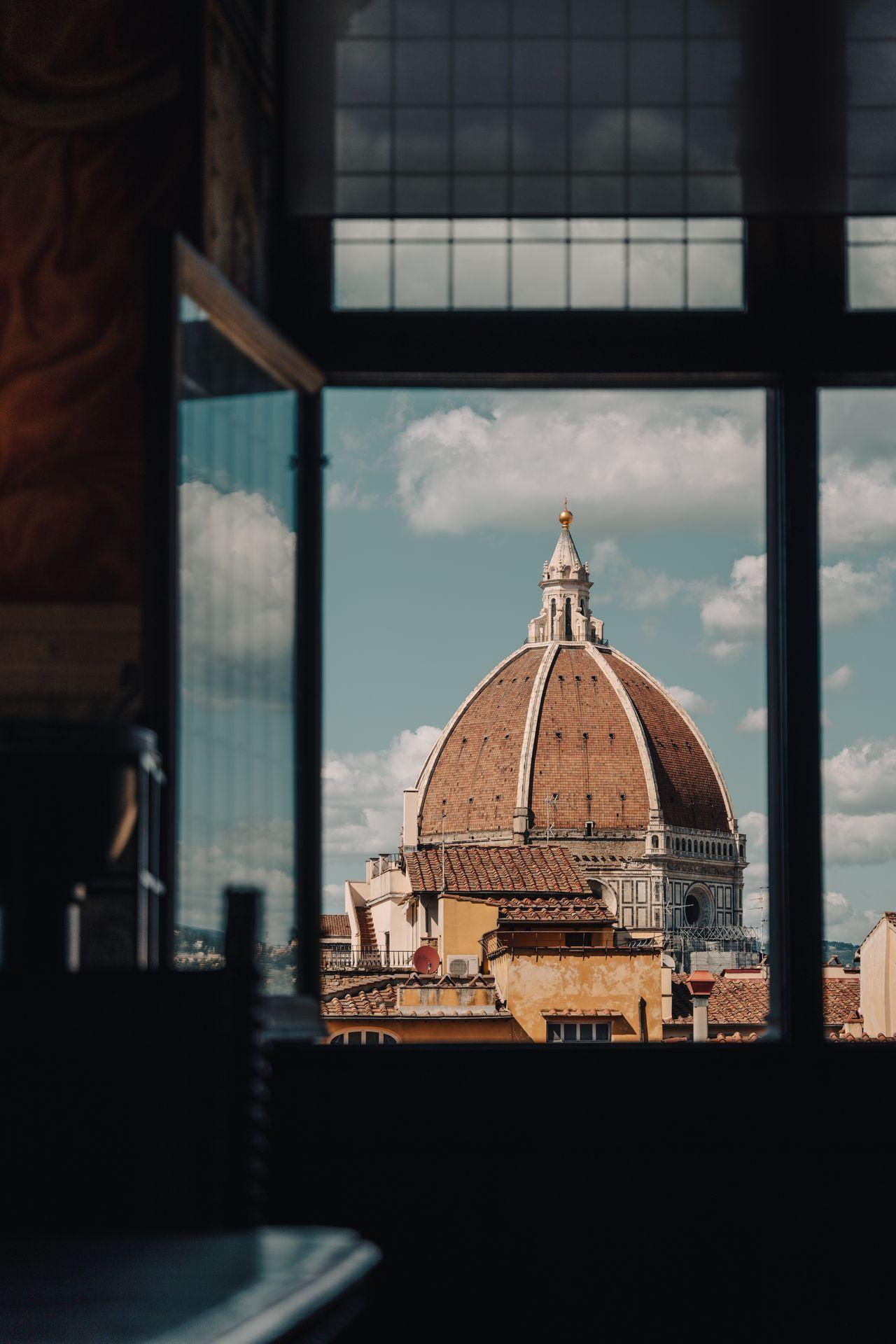
After following this itinerary, returning to the Dome means seeing it differently. No longer simply as an extraordinary feat of engineering, but as the most visible expression of an architectural vision that Brunelleschi left throughout Florence.
Palazzo Ruspoli: Brunelleschi Before Your Eyes, Every Day
Just a few steps from the Duomo, Palazzo Ruspoli offers a privileged starting point for following this itinerary.
Its proximity to the Cathedral allows you to begin with the Dome and then move beyond it, crossing Florence in search of the architect's other works. San Lorenzo, Piazza Santissima Annunziata, Santa Croce and, across the Arno, Santo Spirito become stages of a journey through both the city and the history of architecture.
And as you return towards Palazzo Ruspoli, the Dome reappears between the streets of the historic centre. The same Dome as before, perhaps, but after discovering Brunelleschi beyond his most famous masterpiece, one with a little more to tell.
Discover Brunelleschi's Florence
Be inspired by our recommendations and follow the great architect's footsteps through churches, chapels, and places that tell the story of the birth of the Renaissance.
Contact us